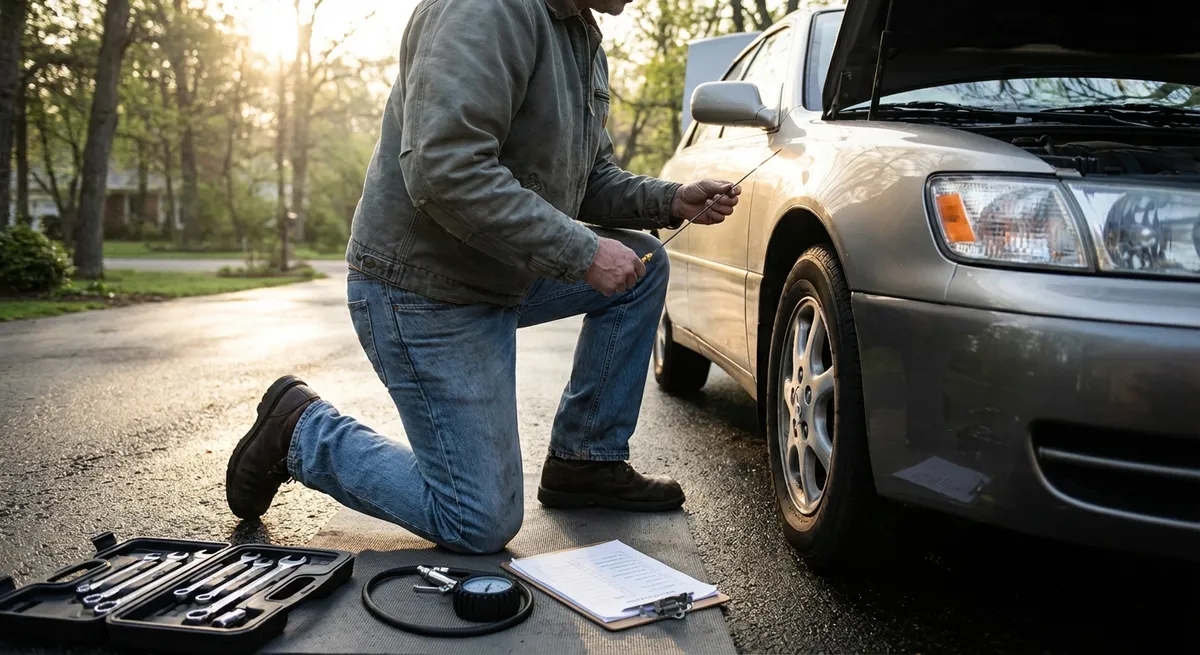
Below is a maintenance game plan built around five pro-level practices you can start using today, even if you’re new to working on cars.
Start With a Baseline: Learn Your Car’s Real Condition
Before you can maintain your vehicle like a pro, you need to know where you’re starting from. Professionals always begin with a baseline inspection.
- Read the owner’s manual, not just blogs.
Your manual lists factory maintenance intervals, fluid specs, and torque values for critical fasteners. Online advice is generic; the manual is specific to your engine, transmission, and climate assumptions.
- Do a structured walk-around.
With the car parked on level ground, check:
- Tires: look for uneven wear, bulges, exposed cords, or sidewall cracks.
- Lights: test headlights (low/high beam), turn signals, brake lights, reverse lights, and hazards.
- Glass and mirrors: chips, cracks, loose mirror housings.
- Underbody: look for new wet spots on the ground (oil, coolant, fuel, or transmission fluid).
- Peek under the hood once a month.
- Check coolant reservoir level and color.
- Inspect belts for cracks, glazing (shiny surfaces), or fraying.
- Look at hoses for swelling, soft spots, or oil contamination.
- Note any unusual smells (fuel, burnt oil, sweet coolant).
- Scan for stored diagnostic codes if possible.
With the engine cold:
A basic OBD-II scanner is inexpensive. Even if your check engine light isn’t on, some intermittent codes may be stored. Record them and watch for patterns—this is exactly what a good shop does for long-term customers.
Establishing this baseline turns future changes into valuable clues instead of surprises. It also helps you decide which maintenance items need attention now versus later.
Make Fluids a Priority: The Lifeblood of Every System
Professionals know that fluids tell the story of a car’s health. You don’t need to be an expert chemist to interpret the basics; you just need a method.
- Engine oil: Track both miles and time.
- Follow the shorter of the two: mileage interval or time interval (often 6–12 months).
- If you drive many short trips, your oil may degrade faster due to fuel dilution and moisture.
- Check the dipstick monthly: level, color, and smell. Dark oil isn’t automatically bad, but metallic sparkle, a strong fuel smell, or a milky appearance are red flags.
- Coolant: More than “green or not.”
- Different vehicles use different coolant chemistries (HOAT, OAT, etc.). Mixing them can cause sludge formation. Always match the manufacturer’s spec.
- Inspect the coolant only at the reservoir when cold; never remove a hot radiator cap.
- Look for rusty discoloration, debris, or oil-like films—these suggest internal corrosion or head gasket issues.
- Brake fluid: Treat it like a safety component, not an afterthought.
- Brake fluid is hygroscopic—it absorbs moisture from the air, reducing boiling point and encouraging internal rust.
- Many manufacturers recommend brake fluid replacement around every 2–3 years, regardless of mileage. This is one of the most ignored but critical services.
- Transmission and power steering fluids: Follow the specific spec.
- Do not substitute “universal” fluid unless it explicitly meets the exact standard in your manual.
- For sealed transmissions with no dipstick, don’t guess. If shifts feel harsh or delayed, have a professional evaluate before simply draining and filling.
Keeping fluids within spec doesn’t just prevent breakdowns—it preserves expensive components like engines, transmissions, and ABS modules that can easily cost more than the vehicle is worth.
Respect Tires and Brakes: Your Only Contact With the Road
Mechanically, tires and brakes do the heaviest safety work. A spotless engine bay means nothing if you can’t stop or steer reliably.
- Set tire pressures by the door placard, not the sidewall.
- The sidewall shows maximum pressure, not the recommended operating pressure.
- Use the label in the driver’s door jamb or the owner’s manual.
- Check pressures at least monthly and before highway trips. Temperature swings can change pressure by several PSI.
- Rotate and inspect, don’t just rotate.
- Rotation (often every 5,000–7,500 miles) helps even wear, but use that wheel-off time to:
- Inspect brake pads and rotors for thickness and scoring.
- Look at inner sidewalls where many drivers never glance.
- Check for cracked valve stems and missing lug studs.
- Listen and feel your brakes.
- Squealing that stops when you apply the brakes can indicate worn pad wear indicators.
- Pulsation in the pedal or steering wheel during braking often points to rotor thickness variation or warping.
- A soft or sinking pedal is an immediate stop-driving-and-inspect-now condition.
- Replace based on condition, not just mileage myths.
- Tires with deep tread can still be unsafe if they’re old (often ~6–10 years max; check DOT date codes).
- Brake pads should be replaced before they reach minimum thickness—don’t wait for metal-on-metal noise that damages rotors.
Treating tires and brakes like high-priority wear items instead of “fix it when it screams” components is one of the clearest differences between a well-maintained car and a neglected one.
Build a Simple Service Calendar (and Stick To It)
Shops don’t rely on memory; they rely on systems. You should too. A basic, written or digital maintenance schedule will save you money and prevent rushed, emergency decisions.
- Separate tasks into three buckets.
- Critical safety (time-based): brake fluid, coolant, timing belts, airbags recalls.
- Routine “wear and tear”: oil changes, filters, wiper blades, tire rotations, brake pads.
- Condition-based checks: alignment, suspension components, battery tests.
- Use mileage and time, not one or the other.
- Create a table with each item, the recommended mileage, and maximum time interval.
- Example: “Oil: 7,500 miles or 1 year (whichever comes first)” and log the date/mileage of each service.
- Automate reminders.
- Use a calendar app or dedicated car-maintenance app and set recurring reminders.
- Include buffer time (e.g., reminder at 6,500 miles for a 7,500-mile oil change) to avoid slipping past intervals.
- Keep records like a professional shop.
- Maintain a folder (physical or digital) with receipts, part numbers, and notes on any issues.
- Record brand and viscosity of fluids, filter types, and torque specs used for critical fasteners.
- This log boosts resale value and helps diagnose future issues quicker.
A disciplined schedule doesn’t make you obsessive—it makes you efficient. You’ll know what’s coming up, what can wait, and where you can safely stretch intervals based on your actual driving.
Use Pro-Level Habits During Every DIY Job
How you perform maintenance matters as much as what you perform. Adopting a few professional habits can prevent many DIY-induced problems.
- Work from verified information, not guesswork.
- Use a reputable repair manual or OEM service information for your specific year, make, and model.
- Don’t rely on random forum torque values or fluid capacities; cross-check them.
- Follow a clean, organized workflow.
- Lay out tools and parts before you start.
- Use labeled containers or magnetic trays for bolts from each component.
- Take photos as you disassemble, especially for hose routing and connector locations.
- Use torque wrenches, not “good and tight.”
- Over-tightening drain plugs, wheel lugs, and spark plugs is one of the most common DIY mistakes.
- Always use the specified torque value and a calibrated torque wrench on critical fasteners.
- Replace associated parts when it makes sense.
- If you’re replacing brake pads, inspect or replace hardware (shims, clips, pins) and consider new rotors if they’re near minimum thickness or badly scored.
- When doing a timing belt, many manufacturers recommend also replacing the water pump, tensioners, and idlers. Labor overlap makes this cost-effective.
- Perform a post-service check and short test drive.
- Before closing the hood, verify: fluid levels, caps tight, no tools left behind, no disconnected plugs or vacuum hoses.
- On the first drive, listen carefully and recheck for leaks afterward—professionals always inspect their own work.
With these habits, you’re not just “changing parts”; you’re maintaining your vehicle in a way that aligns with how competent shops work every day.
Conclusion
A reliable car is rarely an accident—it’s the result of consistent, informed attention. By establishing a clear baseline, prioritizing fluids, respecting tires and brakes, building a realistic service calendar, and adopting pro-level work habits, you can dramatically reduce surprise repairs and extend the life of every major system in your vehicle.
You don’t have to become your own mechanic overnight. Start with one or two habits from this guide—monthly fluid checks, proper tire pressure, or a simple service log—and build from there. Over time, you’ll spend less on emergency fixes, more on planned maintenance, and you’ll understand your car well enough to make confident decisions whether you’re holding a wrench or a repair estimate.
Sources
- NHTSA – Vehicle Maintenance for Safety – U.S. National Highway Traffic Safety Administration guidance on tire care, brakes, and general vehicle safety checks
- Car Care Council – Car Care Guide – Industry-supported nonprofit offering detailed maintenance interval recommendations and checklists
- AAA – Vehicle Maintenance Resources – AAA’s articles and guides on preventive maintenance, fluids, and seasonal car care
- U.S. Department of Energy – Fuel Economy: Keeping Your Car in Shape – Explains how proper maintenance affects efficiency and system longevity
- University of California, Davis – Vehicle Maintenance & Safety Tips – Practical safety-focused maintenance practices from a major educational institution