Build a Maintenance Schedule That Matches Your Driving
The factory maintenance schedule in your owner’s manual is the baseline, not the full story. It assumes “normal” driving conditions—yet many drivers fall into the “severe duty” category without realizing it: frequent short trips, heavy traffic, extreme temperatures, or towing all qualify and shorten service intervals.
Start by reading both the “normal” and “severe” schedules in your manual. Then honestly assess your real driving: if you sit in stop‑and‑go traffic daily or only take short 5–10 minute trips, follow the severe schedule for fluids and filters. Use a simple spreadsheet, notes app, or maintenance app to track dates, mileage, and services performed. Log oil changes, coolant services, brake work, transmission fluid, tire rotations, and battery replacements.
When you buy a used vehicle, baseline the maintenance: change engine oil and filter, air filter, cabin filter, and brake fluid at minimum unless you have documented proof they’ve been done recently. This resets the clock so you’re not guessing. A documented maintenance log also adds resale value and builds trust with future buyers or shops.
Professional-Level Fluid Care: Oil, Coolant, and Transmission
Fluids are your car’s lifeblood; neglect here is what leads to engine and transmission overhauls. Start with engine oil: follow the correct viscosity and specification (API/ILSAC, Dexos, VW/Audi, BMW Longlife, etc.) listed in your manual—brand matters less than meeting the spec. Modern vehicles often have oil‑life monitors, but they assume ideal conditions; if your driving is mostly short trips, consider changing oil slightly before the monitor hits 0% or past-due.
For coolant, don’t mix types unless the manufacturer explicitly allows it. Different coolants use different corrosion inhibitors that don’t always play well together. Inspect the coolant reservoir monthly: level should be between MIN and MAX, with coolant looking transparent and free of rust or sludge. If it’s brown, murky, or you see oily film, schedule a professional inspection immediately—this can indicate internal gasket or oil cooler issues.
Automatic transmission fluid (ATF) is often marketed as “lifetime,” but that usually means “lifetime of the warranty,” not the lifetime of the vehicle. Check whether your manufacturer specifies a change interval; if not, many professionals recommend a fluid and filter service between 50,000–80,000 miles for traditional automatics, sooner if you tow or drive in hot climates. Avoid high‑pressure “flushes” on neglected transmissions; a drain‑and‑fill with filter change is safer on older or high‑mileage units.
Also pay attention to brake fluid and power steering fluid (if your vehicle has hydraulic steering). Brake fluid is hygroscopic—it absorbs moisture over time, which corrodes components and lowers boiling point. A typical professional recommendation is replacement every 2–3 years regardless of mileage, unless your manufacturer specifies more frequent service. These fluid services are far cheaper than replacing calipers, master cylinders, or steering racks.
Tires, Alignment, and Brakes: Your Safety System Trio
Your tires, alignment, and brakes work as a system: if one is off, the others wear faster and your safety margin shrinks. Start by checking tire pressure monthly when the tires are cold (parked for at least three hours or driven less than a mile). Use the pressure listed on the driver’s door jamb, not the maximum pressure molded on the tire sidewall. Underinflated tires overheat, wear on the shoulders, and increase fuel consumption; overinflated tires wear in the center and reduce grip.
Regularly inspect tread depth with a simple gauge or a U.S. penny: if Lincoln’s head is fully visible, tread is below about 2/32" and the tire is legally worn out in many areas. Most professionals recommend replacement closer to 4/32" for wet climates and 5/32"–6/32" if you frequently encounter snow. Check for uneven wear patterns—feathering, cupping, or one‑sided wear indicate misalignment, worn suspension components, or unbalanced wheels.
Tire rotation every 5,000–8,000 miles (often at each oil change) keeps wear even, which maintains predictable handling and extends tire life. Front tires on front‑wheel drive cars carry more weight and handle both steering and most braking; rotation helps distribute the workload.
For brakes, listen and feel. Squealing, grinding, pulsation in the pedal, or a pull to one side under braking all need prompt attention. Don’t wait for grinding—once pads wear down to metal, they quickly destroy rotors and can overheat calipers. During wheel or tire service, visually inspect pads (where visible through the wheel or caliper inspection window) and note approximate remaining thickness; most shops recommend replacement when friction material is down to 3 mm or less. Brake inspections once a year—or 10,000–15,000 miles—are inexpensive insurance.
Prevent Electrical Surprises: Battery, Belts, and Connections
Modern vehicles are power‑hungry: ECUs, sensors, cameras, and infotainment systems all depend on a clean, stable electrical supply. A weak battery doesn’t just cause no‑start issues—it can trigger strange warning lights, sensor errors, and erratic behavior. Most 12‑volt lead‑acid batteries last 3–5 years; in hot climates, expect the shorter end of that range.
Check your battery terminals 1–2 times a year for corrosion (white or bluish buildup) and ensure clamps are tight. Light surface corrosion can often be cleaned carefully with a mixture of baking soda and water and a dedicated battery brush, but avoid getting liquid into vents on top of the battery. If you’re not comfortable, have a shop clean and test the battery during routine service. A professional load test is the best way to know a battery’s true health.
Drive belt inspection is just as critical. Serpentine belts power the alternator, power steering pump, water pump, and air conditioning. Look for cracks, fraying, glazing (shiny surfaces), or missing ribs. On newer “EPDM” belts, deep cracking may not occur even when worn; your mechanic may use a belt wear gauge. Pay attention to chirping or squealing noises at startup—these can indicate a slipping or misaligned belt, worn tensioner, or bad pulley bearing. A failed belt can mean immediate loss of charging and engine cooling.
Grounds and electrical connections matter more on modern vehicles. If you frequently experience intermittent electrical problems—random warning lights, flickering interior lights, or unstable idle—have a professional check key grounds and connectors before replacing expensive modules. Many “electronic” issues are actually voltage or connection problems.
Professional Inspection Mindset: Catching Problems Early
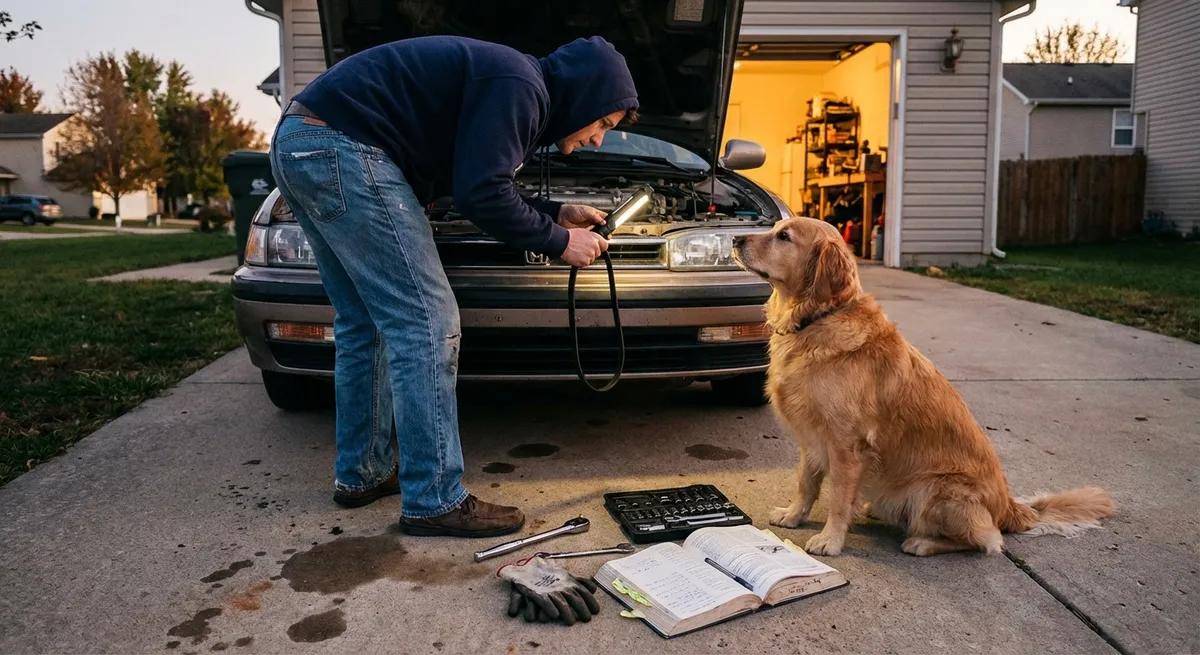
Even if you prefer to do some work yourself, adopting a professional inspection mindset will save you money. Think in terms of systems: engine, cooling, braking, steering/suspension, electrical, and body. Once a month, set aside 10–15 minutes to perform a quick driveway check:
- Walk around the car and look for new dents, rust spots, or fluid on the ground.
- Check all exterior lights: low/high beams, turn signals, brake lights, reverse lights, and hazards.
- Pop the hood and look for leaks, cracked hoses, loose clamps, or unusual smells (fuel, burning oil, coolant).
- Listen to the engine at idle: note any new ticking, knocking, or hissing.
- Check wiper condition and washer fluid.
When you visit a shop, ask for a multipoint inspection and request they prioritize findings into “urgent,” “soon,” and “monitor.” Professional techs look for patterns: a small seep today can become a major leak next season; a minor suspension bushing crack can turn into a steering issue if ignored. Keep the report and compare it to the next visit—trends matter more than single snapshots.
Finally, choose shops and parts wisely. Use OEM (original equipment manufacturer) or high‑quality aftermarket parts for critical systems like brakes, steering, and engine management. Cheap components often wear faster or perform inconsistently, which can undo the benefits of good maintenance. Build a long‑term relationship with a reputable shop that understands your vehicle and your driving habits; continuity of care is as valuable for cars as it is for people.
Conclusion
Reliability isn’t luck—it’s the result of a few consistent, informed habits. Matching your maintenance schedule to your real driving, treating fluids as critical components, respecting the tire‑alignment‑brake system, managing your car’s electrical health, and thinking like a professional during inspections will prevent most surprise failures. Use this playbook as your baseline, adapt it to your vehicle and climate, and you’ll keep your car safer, more efficient, and on the road far longer than the average driver.
Sources
- NHTSA – Vehicle Maintenance & Safety - U.S. government guidance on basic maintenance and its impact on safety
- Car Care Council – Car Care Resources - Industry-backed, consumer-focused information on preventive maintenance schedules and best practices
- AAA – How Long Do Car Batteries Last? - Data and expert advice on battery life expectancy and replacement timing
- Tire Rack – Tire Tech Information - Technical articles on tire pressure, tread wear, rotation patterns, and replacement thresholds
- Penn State Extension – Automotive Cooling Systems - Educational overview of engine cooling, coolant types, and maintenance considerations