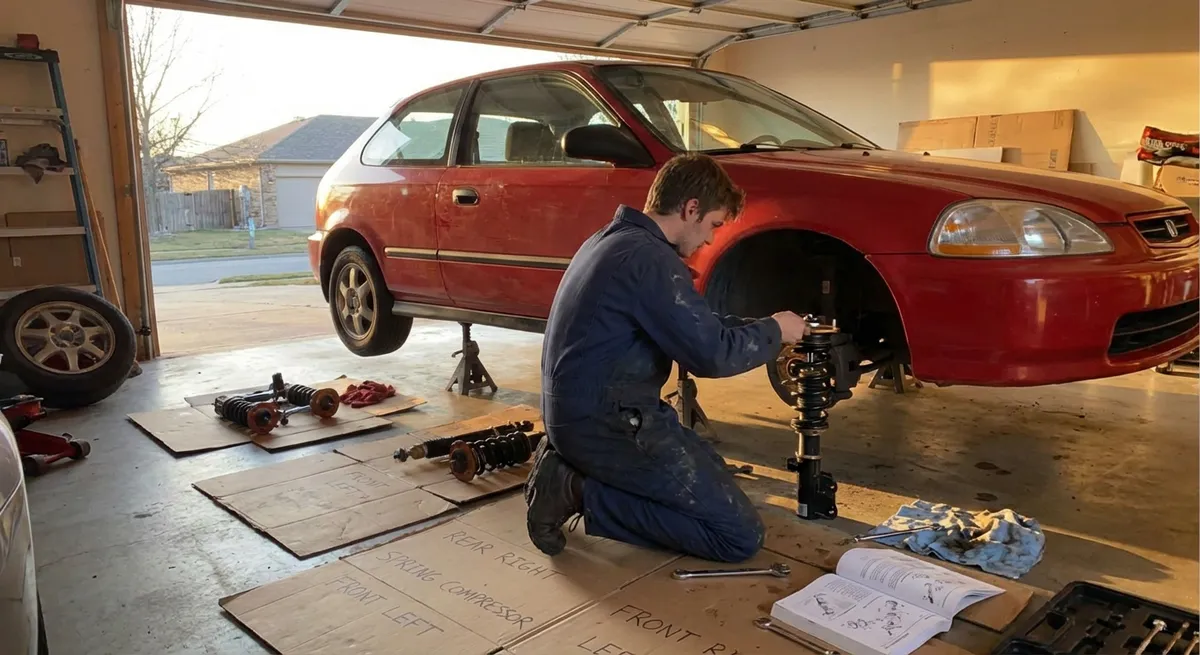
Understanding What Your Suspension Really Does
Your suspension is more than “springs and shocks.” It’s a system that keeps your tires in consistent contact with the road while controlling body movement.
Key components you should recognize before you start:
- Springs (coil or leaf) – Support vehicle weight and set ride height.
- Shocks/struts – Control spring motion so the car doesn’t bounce. Struts also act as structural components and mount points for other parts.
- Control arms and bushings – Locate the wheels and allow controlled up-and-down motion.
- Ball joints and tie-rod ends – Pivot points that let the wheels steer and move with the suspension.
- Sway bar (stabilizer bar) and links – Resist body roll during cornering.
Think of this system as a chain: one weak link—worn bushing, leaking strut, or loose ball joint—can affect how the entire car feels and responds. Before you touch a wrench, you need a clear picture of what’s healthy and what’s not.
Safety First: How to Set Up a Solid DIY Work Area
Suspension work means you’ll be under or beside a vehicle that’s off the ground. That’s where many DIYers make dangerous shortcuts. Treat setup like part of the repair, not an afterthought.
Follow these safety fundamentals:
- Work on level, solid ground. Avoid slopes, dirt, gravel, or soft asphalt that can let stands sink or shift.
- Use the parking brake and wheel chocks. Chock the wheels that stay on the ground—front and rear—especially if you’re lifting one end only.
- Never trust a jack alone. Use a floor jack to lift, then always support the vehicle with rated jack stands under solid points (frame, pinch welds, or subframe as specified in your owner’s manual).
- Test stability before you get underneath. Once the car is on stands, push firmly on the body from multiple directions. If there’s any wobble or movement, re-position.
- Wear PPE. Safety glasses, gloves, and closed-toe shoes are non-negotiable. Road grit, rust flakes, or a snapped spring clip can injure you quickly.
A stable vehicle and organized workspace will make every other step safer and faster—exactly how professionals operate.
Professional Tip 1: Do a Structured “Feel” Test Before You Grab Tools
Before you jack the car up or remove a single bolt, capture how the suspension behaves on the road. That’s how pros narrow down problems quickly.
On a safe test drive:
- Over small bumps:
- A rapid, chattering vibration suggests worn shocks/struts or loose sway bar links.
- A single, solid “thunk” from one corner suggests a loose or worn joint or bushing.
- After a speed bump:
- The body should compress, rebound once, then settle.
- If it continues to bounce more than 1–2 times, suspect weak shocks/struts.
- During braking:
- Excessive front-end dive can point to tired front struts or soft front springs.
- A pull to one side can be alignment, brake, or suspension-related, so note the conditions carefully.
- In gentle lane changes:
- Excessive lean/roll hints at worn sway bar components or weak springs.
- A delayed reaction or “floaty” feeling says damping (shock/strut) is compromised.
Write down what you feel and which side it seems to come from. This “pre-diagnosis” lets you focus your inspection and avoid turning a simple fix into a guesswork parts swap.
Professional Tip 2: Master the Basic Visual and Hands-On Suspension Check
With the vehicle safely supported, you can perform a surprisingly effective inspection using your eyes, hands, and a pry bar.
Work methodically from the tire inward, on each corner:
Tires and wheels:
- Check for uneven wear: - Inner or outer edge wear suggests alignment or worn suspension components. - Cupping (scalloped patches) often points to worn shocks/struts. - Spin the wheel by hand (if off the ground) and listen for grinding or roughness (possible bearing issue).
Shocks and struts:
- Look for oil seepage down the body of the shock/strut. Light misting can be normal; wet, oily streaks are a fail. - Inspect mounting points and rubber bushings for cracks, separation, or metal-on-metal contact.
Springs:
- Inspect coils for cracks, missing pieces, or rust flaking that has eaten deeply into the metal. - Note if one side of the car sits visibly lower (measure from wheel center to fender lip if needed).
Control arms and bushings:
- Use a flashlight. Look for torn, split, or pushed-out bushings. - Insert a pry bar near the bushing and apply gentle pressure. Excess movement, clunks, or exposed shiny metal indicate wear.
Ball joints and tie-rod ends:
- With the wheel off the ground, grasp it at 12 and 6 o’clock and rock it. Play here may indicate ball joint or bearing wear. - Grasp at 3 and 9 o’clock and rock; movement here may point to tie-rod end play. - You’re feeling for looseness, clicks, or clunks, not normal compliance from rubber components.
Document anything suspicious with photos. This makes it easier to compare wear over time or consult a professional if you’re unsure.
Professional Tip 3: Clean, Inspect, and Protect—The Maintenance Most Drivers Skip
You may not be rebuilding struts in your driveway, but you can significantly extend suspension life by cleaning and protecting what’s already there.
Add this routine to your maintenance calendar (every 6–12 months in most climates, more often where roads are salted):
- High-pressure rinse the undercarriage.
- Focus on wheel wells, control arms, springs, and mounting points to remove road salt and dirt.
- Do this after winter and after any off-road or coastal driving.
- Brush and wipe components.
- With the wheel removed, use a stiff plastic brush or old toothbrush to remove caked-on debris from springs, perches, and brackets.
- Wipe down shocks/struts to clearly see any fresh leaks over time.
- Check and tighten non-stretched fasteners.
- If your manual specifies periodic torque checks (common on off-road or performance models), use a torque wrench to verify.
- Only tighten to spec—overtightening can crush bushings or strip threads.
- Apply rust prevention where appropriate.
- On clean, dry, non-moving metal surfaces (frames, brackets, spring perches), use a quality rust-inhibiting coating.
- Avoid spraying rubber bushings, joints, or brakes.
This is the sort of low-cost, high-return work that separates “the car just passed inspection” from “the car feels tight and solid at 150,000 miles.”
Professional Tip 4: Replace Worn Parts in Pairs and Plan for an Alignment
When it’s time to replace parts, copying professional habits will save you money and headaches long-term.
Key rules to follow:
- Do both sides on the same axle.
- Shocks, struts, springs, and many bushings should be replaced in pairs (left and right).
- Mixing an old, soft component with a new, firm one on the same axle can create unpredictable handling and uneven tire wear.
- Use complete assemblies when it makes sense.
- Many modern vehicles offer loaded struts (spring, mount, and strut pre-assembled).
- These reduce installation risk, eliminate the need for a spring compressor, and ensure the upper mounts are new as well.
- Always consider alignment after front-end work.
- Any change to tie rods, control arms, ball joints, struts, or ride height can alter alignment angles.
- Budget for a professional alignment immediately after front-end suspension replacement. It’s cheaper than a set of prematurely ruined tires.
- Follow torque specs and tightening procedures.
- Suspension hardware is often torque-to-yield or has specific “torque at ride height” instructions.
- Use a quality torque wrench and, where specified, do the final tightening with the suspension loaded (vehicle weight on wheels or simulated).
Think of this step like finishing a brake job by properly bleeding and bedding pads—it’s what turns a parts swap into a safe, predictable repair.
Professional Tip 5: Build a Repeatable DIY Suspension Check Schedule
Professionals don’t rely on memory—they rely on intervals. You can do the same to catch developing issues before they become unsafe or expensive.
Here’s a practical DIY schedule:
- Every oil change (or ~5,000–7,500 miles):
- Quick visual wheel-well check for leaks, broken springs, or obvious damage.
- Glance at tire wear and listen for new clunks or rattles during driving.
- Twice a year (spring and fall):
- Basic undercarriage rinse and wheel-well cleaning.
- Inspect shocks/struts, springs, and bushings as described earlier.
- Check for new rust or scaling around structural mounting points.
- Annually or before long trips:
- Full hands-on play test (wheels at 12/6 and 3/9 o’clock).
- Confirm no fluid leaks from shocks/struts.
- Review alignment history and tire wear; if steering feels off-center or tires show uneven wear, schedule an alignment check.
Keep a simple log (notebook or notes app) with mileage, findings, and any parts replaced. Over time, you’ll see patterns: which components wear faster, how your environment affects corrosion, and when it’s smart to plan larger suspension work before it becomes urgent.
Conclusion
You don’t need a lift or a full toolbox to make a real impact on your vehicle’s suspension health. By driving with a diagnostic mindset, setting up a safe work area, performing structured inspections, replacing parts intelligently, and following a simple schedule, you’ll keep your car riding smoother, steering more precisely, and stopping more predictably.
The suspension system is one of the biggest safety and comfort factors on your vehicle—and it’s also one of the easiest systems for a careful DIYer to monitor effectively at home. Start with a thorough inspection, log what you find, and tackle the work that fits your comfort and tool level. For anything beyond that line, your detailed observations will help a professional technician diagnose and repair your car more efficiently and accurately.
Sources
- [NHTSA – Vehicle Maintenance Tips](https://www.nhtsa.gov/features/vehicle-maintenance) - Federal safety guidance on maintaining critical vehicle systems, including suspension-related checks
- [AAA – How to Check Your Car’s Suspension System](https://exchange.aaa.com/automotive/automotive-research/how-to-check-your-cars-suspension-system/) - Practical overview of suspension components and basic inspection methods
- [Bridgestone Tires – Understanding Tire Wear Patterns](https://www.bridgestonetire.com/learn/maintenance/what-causes-tire-wear/) - Explains how different tire wear patterns can indicate suspension and alignment issues
- [Monroe Shocks & Struts – Suspension Inspection Guide](https://www.monroe.com/en-us/support/technical-resources/suspension-inspection.html) - Manufacturer’s technical guidance on identifying worn shocks, struts, and related components
- [U.S. Department of Transportation – Winter Driving and Vehicle Maintenance](https://www.transportation.gov/winter-driving) - Covers the importance of undercarriage cleaning and corrosion prevention in harsh conditions