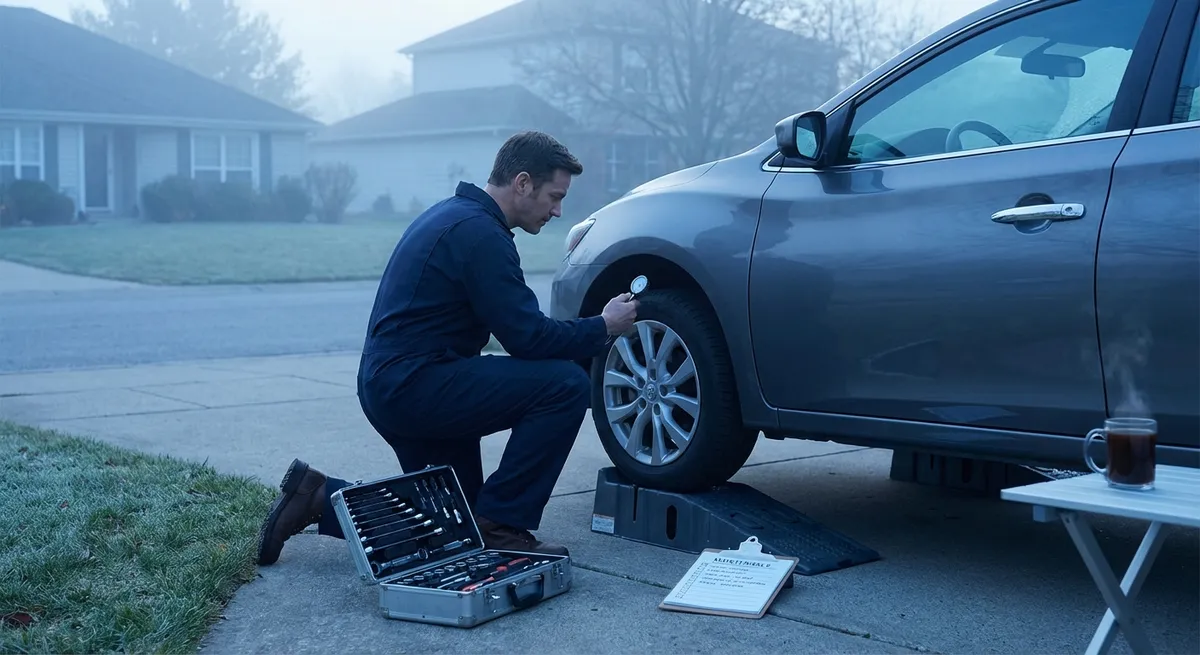
Build a “10-Minute Check” Habit That Catches Problems Early
Most expensive failures start as small issues that go unnoticed. A quick visual inspection once a week can flag emerging problems before they turn into breakdowns.
Take 10 minutes with the car parked on a level surface, engine off, and hood cool:
- Walk around the car and look at all four tires. Check for uneven wear, bulges, visible cords, or screws/nails. Uneven edges often point to alignment or suspension problems.
- Turn the steering wheel full left and right with the engine off; look through the wheel openings for cracked rubber boots on ball joints, tie rods, or CV axles. Torn boots let dirt and moisture in, and that’s when wear accelerates.
- Pop the hood and look for dried coolant trails (white/green/pink crust), oil residue, or damp spots around hoses and connections. These “stains” are red flags that something is seeping.
- Check for loose or frayed accessory belts. A belt that looks glazed (shiny) or cracked is nearing the end of its life.
- Glance at the brake fluid reservoir, coolant overflow tank, and power steering reservoir (if hydraulic). If levels are dropping between oil changes, you may have a leak somewhere in that system.
- Look under the car where you normally park. New wet spots or stains (oil, coolant, transmission fluid) are often the first sign of a developing leak.
This 10-minute ritual doesn’t replace professional inspections, but it makes those inspections more effective because you can describe what you’re seeing and when it started.
Professional Tip #1: Treat Fluids as Wear Items, Not Afterthoughts
Fluids don’t just “exist” in your car—they perform critical work and break down over time. Thinking of them as wear items, just like brake pads and tires, changes how you maintain them.
Key points and practical intervals (always confirm in your owner’s manual):
- Engine oil: For most modern cars on synthetic oil, 5,000–7,500 miles is a safe service window. Short-trip or severe-use driving (stop-and-go, extreme temps, towing) justifies the lower end of that range.
- Automatic transmission fluid (ATF): Often neglected until problems appear. If your manufacturer gives a service interval, take it seriously—commonly around 30,000–60,000 miles. If they say “lifetime,” shops that see real-world failures still recommend periodic changes, especially for vehicles kept beyond 100,000 miles.
- Coolant/antifreeze: Modern long-life coolants may last 5 years or 100,000+ miles, but only if the system is healthy and the proper mixture is maintained. Overdue coolant loses corrosion protection and can eat away at internal passages.
- Brake fluid: Hygroscopic (absorbs water). Water lowers the boiling point and promotes corrosion inside calipers and lines. A 2–3 year brake fluid flush interval is a solid target.
- Differential and transfer case fluids (for RWD, AWD, 4WD): These gear oils work hard under load. They don’t need frequent service, but ignoring them entirely can destroy expensive driveline parts. Follow manual intervals—often 30,000–60,000 miles in severe use.
Professional practice: when in doubt, use fluids that meet or exceed the exact spec in the owner’s manual (API, ACEA, Dexron/Mercon, etc.). “Close enough” is not good enough for modern drivetrains.
Professional Tip #2: Align Tire Care With Suspension Health
Daily drivers tend to eat tires and suspension components slowly, so many owners don’t notice the problem until the car feels vague or noisy. Integrating tire and suspension checks keeps both systems healthier for longer.
Practical habits:
- Set tire pressures monthly using a quality gauge, always when the tires are cold. Use the pressures listed on the driver’s door jamb, not the max number printed on the tire.
- Rotate tires roughly every 5,000–7,500 miles (commonly done with oil changes). Consistent rotation prevents the front tires from wearing out prematurely due to steering and braking loads.
- Run your hand lightly across the tread. Feathering (smooth one way, sharp the other) often indicates alignment or toe issues; cupping (scalloped dips) can signal worn shocks/struts or balance problems.
- Listen for suspension knocks over speed bumps or dips. A single, dull clunk from one corner often means a worn bushing, sway bar link, or ball joint.
- Pay attention to how the car tracks on a straight road. If it drifts and your tires and roads are good, you likely need an alignment.
Professional rule: whenever you replace steering or suspension parts (tie rods, control arms, ball joints, struts), schedule a four-wheel alignment soon afterward. New parts installed with old alignment specs will still chew through tires.
Professional Tip #3: Respect the Cooling System—It Saves Engines
Overheating is one of the fastest ways to ruin a modern engine. A well-maintained cooling system almost never surprises you; a neglected one fails suddenly and expensively.
What professionals check and what you can watch for:
- Inspect the radiator and condenser through the grille. Look for bent fins clogged with bugs, leaves, or road debris. Clean carefully with low-pressure water from the back side if possible—never blast fins with a pressure washer.
- Squeeze the upper and lower radiator hoses with the engine cool. They should feel firm and resilient, not rock-hard or mushy. Cracks near the clamps or bulging sections are failure points.
- Use a coolant tester or refractometer if you live in areas with temperature extremes. This confirms proper freeze and boil protection and the correct coolant concentration.
- Monitor warm-up behavior. A stuck-open thermostat causes slow warm-up and poor heater performance; stuck closed leads to rapid overheating.
- Watch for the cooling fan cycling on and off once the engine is warm (or when the A/C is on). No fan when hot often points to failed relays, sensors, or the fan motor.
- At the first sign of overheating (temp gauge climbing, warning light, steam), pull over safely and shut the engine off. Do not open the radiator cap on a hot engine.
Professional take: replacing aging hoses, a worn radiator cap, and a suspect thermostat proactively is far cheaper than an overheated engine and warped cylinder head.
Professional Tip #4: Keep Brakes in “Like-New” Condition, Not Just “Not Screaming”
Many drivers wait for grinding or squealing before dealing with brakes. By then, damage is already happening. Professionals think in terms of brake performance and system health, not just pad thickness.
What to watch and how to act:
- Pay attention to pedal feel. A long, spongy pedal can indicate air in the system, old fluid, or flexing rubber hoses.
- Light vibration or pulsing under braking (especially at highway speeds) often points to uneven rotor thickness or warping. Resurfacing or replacing rotors with the pads is usually the correct repair.
- Any pulling to one side during braking suggests a sticking caliper, uneven pad wear, or issues in the hydraulic system.
- Even if you DIY brake jobs, plan on a full caliper service: clean and lubricate slide pins with proper high-temp brake grease, ensure pads move freely in brackets, and inspect dust boots for tears.
- Don’t top off brake fluid just to “make it full.” As pads wear, fluid drops. If you keep topping it off, you mask a useful wear indicator and risk overfilling when someone later pushes the caliper pistons back.
Professional habit: inspect brakes with the wheels off at least once a year. Check pad thickness on both inner and outer pads (inners often wear faster), rotor condition, hose cracking, and any fluid seepage around pistons or fittings.
Professional Tip #5: Make Electrical Reliability a Priority, Not an Afterthought
Modern cars are software on wheels. Weak electrical systems and poor connections create weird, intermittent problems that are hard to trace. Basic electrical maintenance goes a long way.
Key steps to keep your daily driver’s electronics stable:
- Inspect the battery terminals twice a year. Clean white/green corrosion with a proper battery cleaning brush and a baking soda/water solution if needed. Corrosion increases resistance and can starve modules of stable voltage.
- Check the battery age (date code label). Most OEM batteries last 4–6 years under normal use. If you’re near or past that, have it load-tested and budget for replacement before winter.
- Ensure the battery is securely clamped. A loose battery vibrates and can crack internal plates or damage cables.
- Look at visible grounds and main power cables. Loose or corroded ground points can cause random sensor codes, dim lights, or intermittent no-start conditions.
- Avoid cheap “universal” electrical connectors for critical repairs. Use proper crimp connectors, heat-shrink tubing, or solder where appropriate, and route wiring away from hot exhaust parts and moving components.
- If you install accessories (dash cams, chargers, lights), use an add-a-fuse to tap into fuse panels properly instead of jamming bare wires into existing circuits.
Professional mindset: any time you see multiple unrelated warning lights or strange intermittent electrical behavior, suspect a voltage or grounding issue before chasing every individual code.
Putting It Together: A Practical Maintenance Roadmap
To turn all of this into something you can actually follow, think in terms of layers:
- Every week or two: 10-minute check (tires, fluids, leaks, quick visual under hood).
- Every oil change: rotate tires, inspect suspension and brakes, check for new fluid seepage, review service history (what’s coming due next).
- Annually: full brake inspection, coolant system check, cabin and engine air filter inspection, battery and charging system test.
- Every 2–3 years: brake fluid flush, more thorough inspection of hoses, belts, and suspension bushings; consider a professional alignment check.
- Based on mileage/manual: engine coolant, transmission fluid, differential/transfer case fluids, spark plugs, and major belt service.
Reliable commuting isn’t about obsessing over every squeak—it’s about a disciplined, repeatable routine that catches problems early and fixes them properly. Approach your car the way a professional shop would: small, consistent attention, correct parts and fluids, and no shortcuts on safety-critical systems.
Sources
- National Highway Traffic Safety Administration (NHTSA) – Vehicle Maintenance - Federal guidance on tire care, pressure, and inspection best practices
- Car Care Council – Car Care Guide - Consumer-oriented maintenance intervals and system checklists used by many professional shops
- AAA – Vehicle Maintenance & Repair - Research-based advice on fluids, brakes, and reliability for everyday drivers
- U.S. Department of Energy – Fuel Economy: Maintenance - Explains how proper maintenance (fluids, tires, filters) affects efficiency and longevity
- Bridgestone Tire – Tire Care & Maintenance - Detailed information on tire inspection, rotation, and alignment from a major tire manufacturer